
Overview
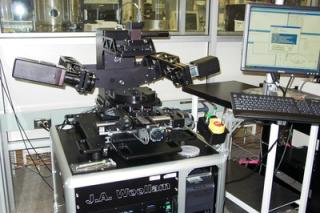
The Woollam tool uses ellipsometry to characterize thin films. Ellipsometry detects the phase change in polarized light as it reflects from or transmits through samples. The Woollam does not directly measure thickness and optical constants, but rather uses collected data to solve models which estimate the thickness and optical parameters of interest. The general sequence of operation is: 1) Measure, 2) Create Model, 3) Fit, 4) Results. The Woollam measures Ψ and Δ which characterize the change in polarization as the light is reflected from the surface. Ψ characterizes the amplitude and Δ characterizes the phase difference.
Processing Technique(s)
Capabilities and Specifications
Substrate Type
Substrate Sizes
Lab Organization, Location, and NEMO Information
Training and Maintenance
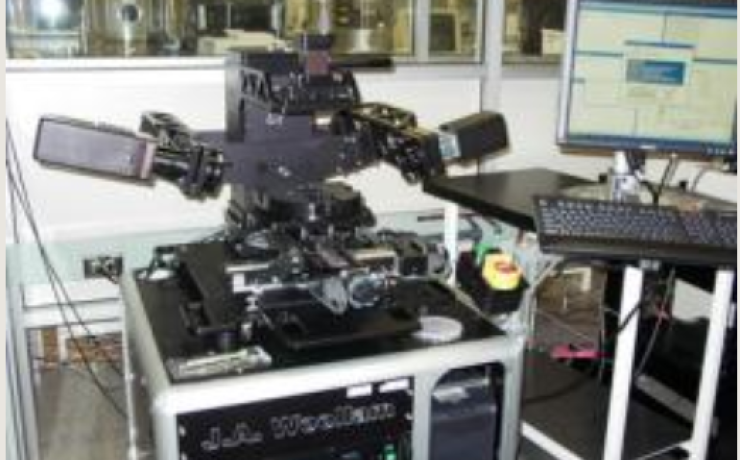
Steps to become a tool user
Become a member of nano@stanford.
Become a member of SNF.
- Study the relevant operating procedures:
Shadow other labmembers who are using the Woollam. Make sure to ask lots of questions and shadow as many times as needed until you feel comfortable that you could run the Woollam on your own.
Contact the primary trainer to schedule both a short written quiz and then a practical hands-on in lab session.